
2026 — The year to end the double taxation of Americans abroad
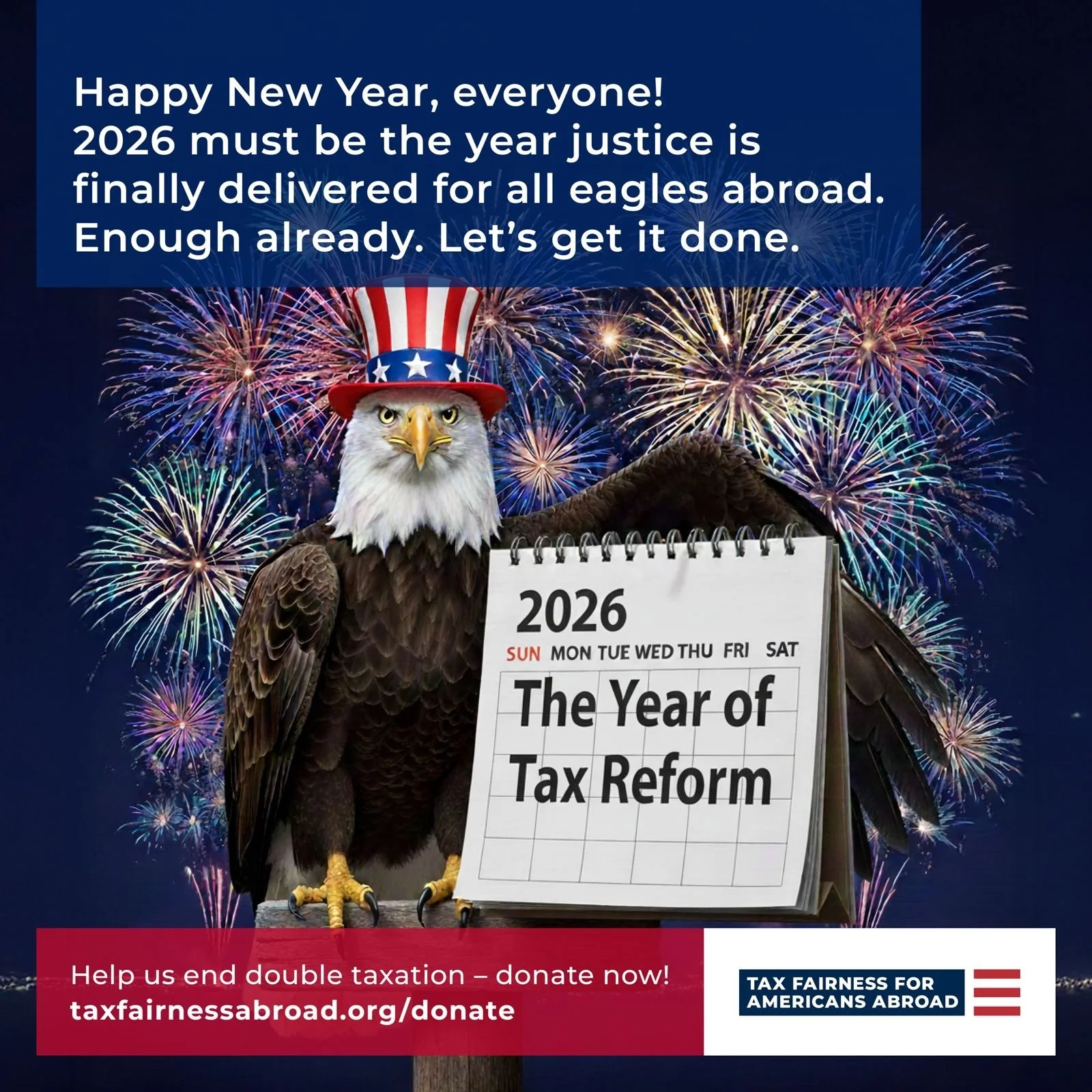
Happy New Year to all Americans abroad!
As 2026 begins, we wanted to share a short update on progress we have made over the past year towards ending double taxation, what still lies ahead, and above all answer the question so many people are asking us: Why are things taking so long?
First, a quick recap of our progress to-date. After Rep. Darin LaHood (R-IL) introduced the Residence-Based Taxation for Americans Abroad Act as a discussion draft in December of 2024, hundreds of people, from experts to lay people, provided detailed comments on the draft. In addition to expressing overwhelming support for the bill, some of those comments identified issues that the original draft had missed. These included issues related to the bill’s treatment of different sorts of trusts. Given their strong belief that getting this bill right at the start would greatly improve its chances for success, the bill’s sponsors went back to work to address as much of the feedback as possible.
As Rep. LaHood’s office joined with Sen. Todd Young’s office to update the bill text, they also began reaching out to the Joint Committee on Taxation, which would have to “score” the bill (provide an estimate of the potential impact on the U.S. Treasury), and to other members of Congress, particularly in the Senate Finance Committee. Discussions with the JCT kicked off in earnest during the summer, and progressed steadily throughout the fall, with deep-dive meetings involving JCT experts in international, business, retirement, and employee benefits taxation taxes working to improve the bill. The overall goal continues to be a bill that addresses the United States’ antiquated citizenship-based taxation while protecting against abuse, all in a legislative package that can secure bipartisan support.
Momentum picks up
In May, the push to end double taxation got a big boost from the election of an American pope, Pope Leo XIV, and the absurd realization that the IRS could audit not only the pope but the entire Vatican, of which the pope is considered to have the ultimate controlling interest. While IRS pressure on the pope and the Vatican is unlikely, the new pope put a bigger spotlight on the tax and compliance burdens that have long weighed on countless Americans living and working abroad.
In July, Tax Fairness for Americans Abroad welcomed two new Board members representing American women overseas and Americans and American business interests in the Asia-Pacific region.
In August, in a guest article on our blog Daniel Bunn, President and CEO of the Tax Foundation, called the double taxation of Americans abroad “a result of bad policy” and called for its repeal, along with the provisions of the Foreign Account Tax Compliance Act (FATCA) that have resulted in many foreign financial institutions denying American citizens even basic banking services.
In September, in another guest article on our blog, Former IRS Commissioner Tom Rettig and Former IRS Counsellor Tom Cullinan publicly called for an end to the double taxation of Americans abroad and a shift towards the international standard of residence-based taxation.
Ever since, the offices of Rep. LaHood and Sen. Young have been working diligently to address stakeholder comments as well as technical issues identified in the JCT review. They expect to re-introduce the bill as early as possible in the new year.
What’s taking so long?
The question that we’ve been receiving from our supporters on an almost daily basis since last fall is “What’s taking them so long?” Many people ask us whether they will still need to file a U.S. tax return in 2026 (simple answer: yes) or 2027 (tbc), or should hold off on the dramatic decision to renounce their U.S. citizenship, which many see as the only other effective means of being able to lead a normal life abroad.
There are two main reasons the process is taking longer than anyone involved had expected or hoped for.
First, ours is not the only issue that has been demanding Congress’ attention. Congress spent all the first half of 2025 negotiating a reconciliation bill, sucking up all the tax-writing committees’ and JCT’s bandwidth. While some people had hoped that Mr. LaHood’s bill could piggyback on the reconciliation bill, Congressional rules and our desire to have a bill that would benefit as many Americans abroad as possible made that impossible. Later in the year, urgent discussions over the health care coverage of millions of Americans again occupied many of the same tax-policy staff whom we needed to vet the bill to improve its chances of garnering bipartisan support and ultimately being enacted into law.
The second is that Rep. LaHood’s and Sen. Young’s offices and JCT are all doing their job properly. Members of Congress rely on the tax policy experts at JCT to give them legal advice on the policy details and a reliable estimate of the impact of important legislation on government revenues not only for the coming year, but for the coming 10 years that make up the federal budget window. And while the short-term impact of the LaHood bill is generally believed to be manageable, they need to seek to identify any loopholes in the bill that could incentivize very wealthy Americans to relocate abroad to dodge U.S. taxes. That could potentially result in a larger revenue gap over time. In recent months, tax advisors to Rep. LaHood and Sen. Young have worked diligently to address those concerns in order to avoid an adverse score, which would jeopardize bipartisan support and make the bill a hard sell in Congress.
Next steps
We expect Rep. LaHood and Sen. Young to complete their technical work, update their companion bills, and reintroduce them in the House and Senate as fast as they can. While the bill is being fine-tuned, we continue our efforts to get the bill on the front burner for the two key Congressional tax committees – the House Ways and Means Committee and the Senate Finance Committee – and ultimately to identify any legislative package in which the bill could be included.
In the meantime, we are preparing an outreach plan that will carry our message beyond the two main tax-writing committees to the whole of Congress and Washington. That will include gently reminding President Trump of his campaign statement, “I support ENDING the Double Taxation of overseas Americans.”
Rep. LaHood and Sen. Young have told us that the testimonials of individual Americans abroad will be crucial to our campaign. The personal stories that we regularly publish on our blog prove that double taxation is not something that only affects the rich, as some in Congress still appear to believe, but millions of ordinary Americans abroad who just want to live normal lives. You should also call your individual members of Congress and urge them to support the LaHood bill when it crosses their desks. It only takes a few minutes per office.
Please help us by continuing to donate to our campaign to enact this important legislation and share your own personal stories of the harm and drama that double taxation, FATCA, GILTI and related rules impose upon Americans abroad. We can only win this battle with your help!
The Team at Tax Fairness for Americans Abroad
If you are an American living abroad and also suffer from double taxation, please help us in the fight for residence-based taxation! Share your own story on our Help us page and Donate using the button below! Our campaign is 100% financed by individual donations and every donation brings us one step closer to winning!