
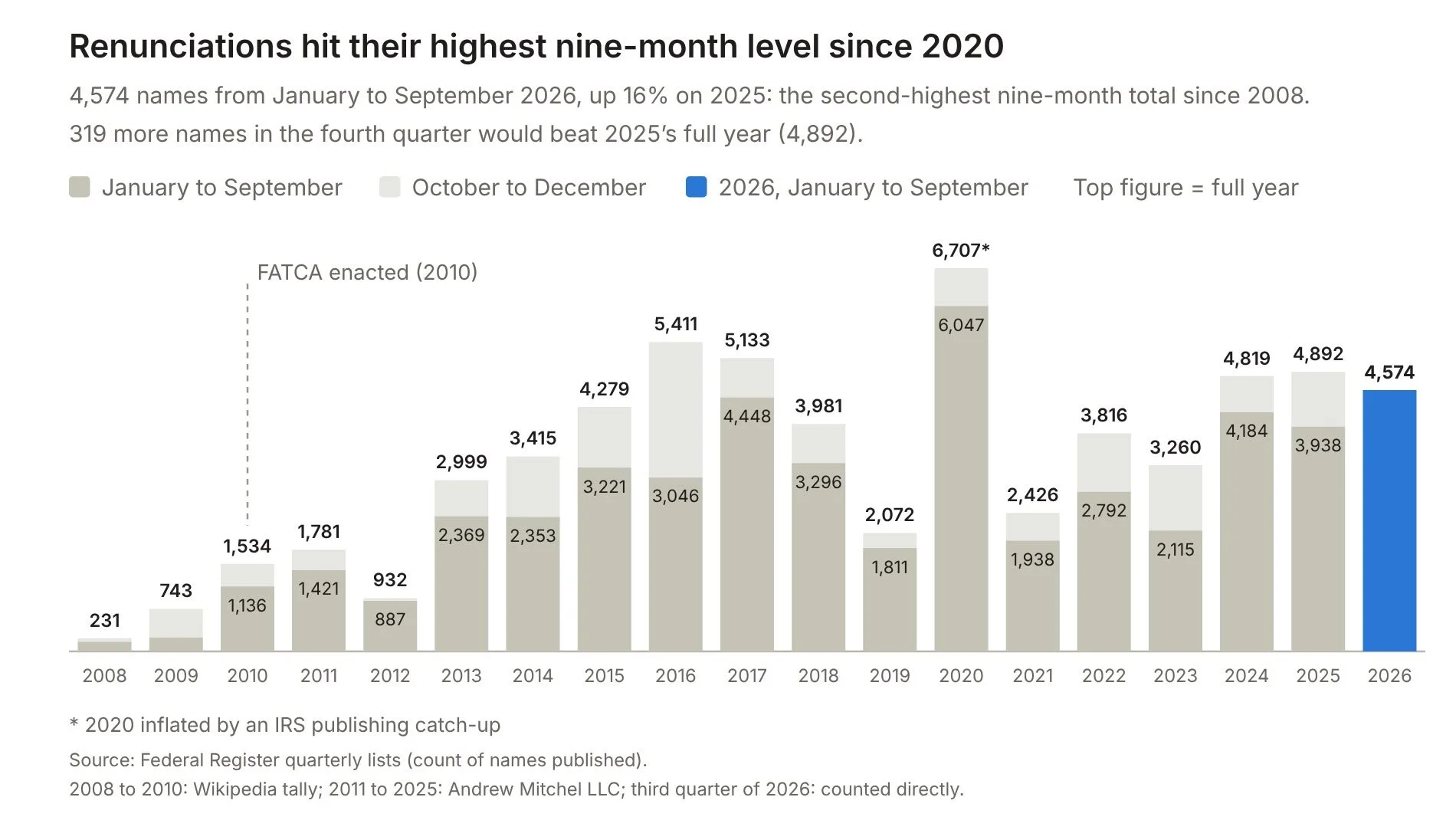
This week, the U.S. Treasury published its latest list of people who gave up U.S. citizenship or long-term residence. It names 1,331 people for the third quarter. Since January, 4,574 names have appeared on these lists, 16% more than over the same period of 2025 and more than in 2024. You have to go back to 2020 to find a higher nine-month total: 2026 ranks second since 2008.
What the Treasury lists show
The 2020 peak is largely artificial. That year, the IRS published a backlog of names: 2019 had been unusually low (2,072 names), with only 183 and 261 names in its last two quarters. According to the Wall Street Journal, about two-thirds of the names published in the first quarter of 2020 belonged to people who had renounced in 2018 or earlier.
The third quarter (1,331 names) was lower than the second (1,781). Swings like this are common, because names appear when the IRS receives the information, sometimes months after someone renounces. Longer periods give a clearer picture. Over the last twelve months, 5,528 names were published, more than in any calendar year since 2008 except 2020. In 2025, the lists contained 4,892 names. With just 319 more names in the fourth quarter, 2026 will be the highest year since 2020. The last quarter of 2025 alone produced 954.
These figures are a floor. People who renounce at a consulate without ever having been part of the U.S. tax system, many accidental Americans among them, often never show up on the lists.
How FATCA changed the picture
In 2012, the Treasury lists contained 932 names. By 2016, they contained 5,411. In between, the Foreign Account Tax Compliance Act (FATCA), passed in 2010, took effect. The law requires banks around the world to report their American customers to the Internal Revenue Service (IRS), and many banks decided it was simpler to close those accounts or turn new American customers away.
FATCA was meant to catch people in the United States hiding money offshore. In practice, it hit millions of Americans who live outside the country and for whom a “foreign” bank is simply the bank down the street. Since 2011, more than 60,000 names have appeared on the Treasury lists.
Taxed where they live, and again by the IRS
Behind FATCA lies a deeper problem. The United States taxes its citizens on their worldwide income wherever they live, a system known as citizenship-based taxation. Eritrea is the only other country that does so. Teachers, retirees, parents and small business owners abroad pay taxes in their country of residence and still have to file with the IRS every year, often with no U.S. tax owed. The testimonials we publish every week show what that means in daily life: college savings that become a tax trap in Canada, parents who cannot invest normally for their children, a British American weighed down by compliance costs.
The government is aware of it. When the State Department decided in March to cut the renunciation fee from $2,350 to $450, its final rule cited “not insignificant anecdotal evidence” of the tax difficulties faced by Americans abroad, partly because of FATCA. It also noted that most of the people who commented did not want to give up their citizenship at all. The fee cut has not shown up in the figures yet. Names reach the list only once the IRS receives the paperwork, often months after the oath, and consular appointments can take a long time to get. Most of those who applied at the new price should appear in 2027.
“Behind every name on this list, there is often a family who would have preferred to remain American,” said Brandon Mitchener, Executive Director of Tax Fairness for Americans Abroad. “They and their families already pay their taxes where they live. What pushes them out is double taxation and local banks and financial institutions that shut their doors to them. It’s time for Congress to end this injustice.”
A bill designed to bring both parties together
Congress can stop this trend by moving towards residence-based taxation, the same approach used by other developed countries. The Residence-Based Taxation for Americans Abroad Act, introduced by Rep. Darin LaHood (R-IL) in the last Congress, would let Americans who genuinely live abroad elect to be taxed by the United States only on their U.S.-source income, like other nonresidents, while remaining full U.S. citizens. It would also help Americans abroad who opt for residence-based taxation keep their local bank accounts, because they could show their bank that they are not subject to FATCA reporting. Safeguards would keep the wealthiest from using it as a loophole: they would be subject to a departure tax, just like high-net-worth individuals who renounce their citizenship today. TFFAA worked with Rep. LaHood on the bill, which was written from the start to win support from Republicans and Democrats alike. Rep. LaHood is expected to re-introduce an updated version of the bill before the end of the year. Our RBT bill FAQ explains how it would work.
President Trump has already set the goal. “Once and for all, I’m going to end double taxation on our overseas citizens,” he told Americans abroad in 2024.
Americans abroad vote in the midterm elections on November 3. Whatever the outcome, Congress already has a ready answer to these numbers. TFFAA calls on Republicans and Democrats in Congress to support the bill, so that the next Treasury list is a shorter one.
Whether or not you are thinking about renouncing your citizenship, please share your story with us. Testimonials like yours are what shape view in Congress.