
Dear Congress,
Buried in a routine report by a university tax clinic serving low-income citizens is a story that captures everything wrong with citizenship-based taxation: an American living in Canada, taken to the United States Tax Court over a summer job worked entirely in Canada.
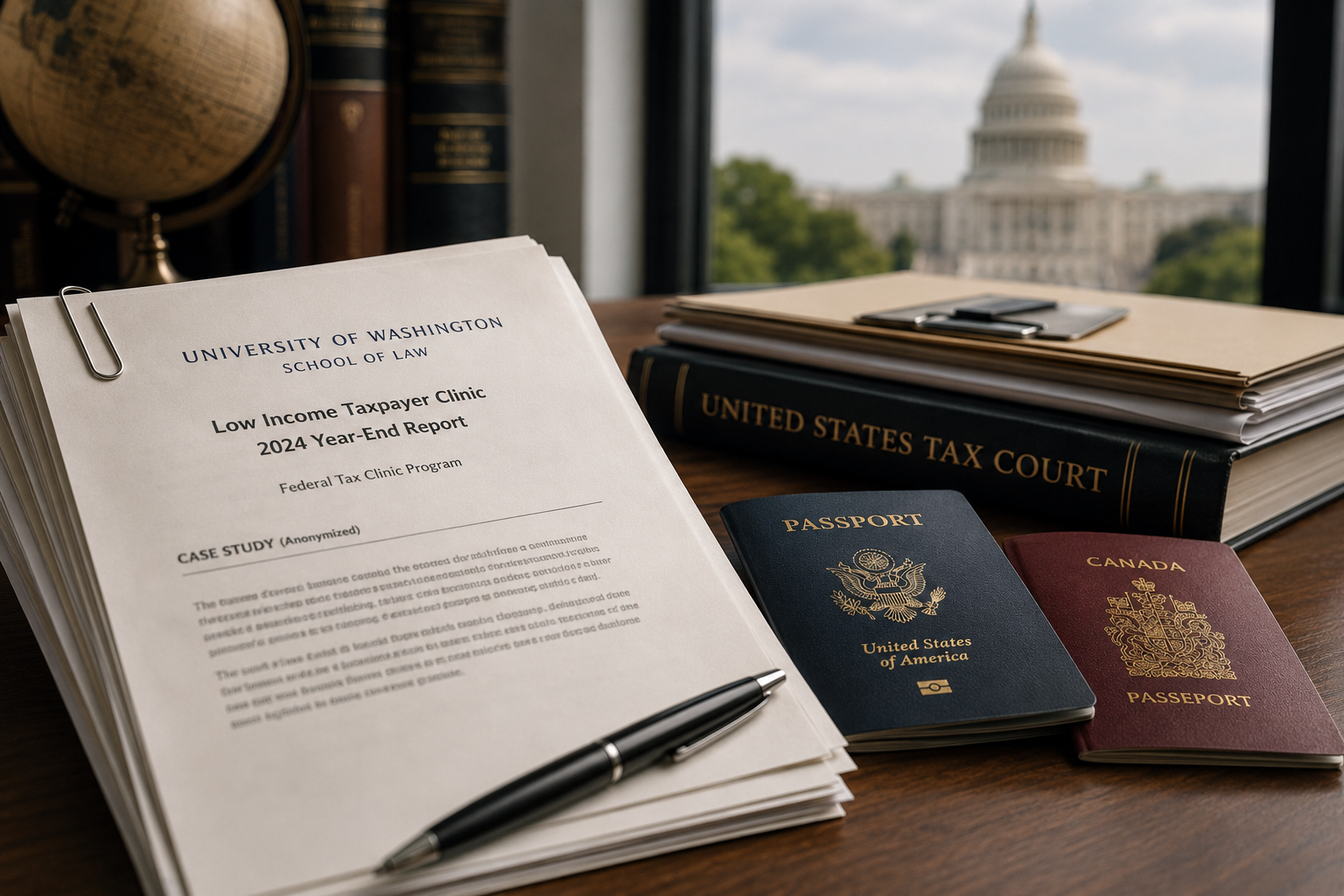
Every year, the Low Income Taxpayer Clinics funded by the IRS submit program reports describing their work. These documents are, by design, dry administrative reading: caseload statistics, training hours, outreach activities. But the 2024 year-end report of the University of Washington’s federal tax clinic, obtained from the university under Washington State’s public records law, contains a case study that demonstrates exactly why millions of Americans abroad need structural reform.
This is only one of several such cases of which we are aware. We have already published the account of Gabriel Morrow, another American who moved to Canada for love and faced similar hurdles.
International dispute over a summer job
The latest story is simple and painfully familiar. A dual citizen of the United States and Canada has lived in Canada for many years and works there. The taxpayer took a summer job, performed in Canada, for a company based in the United States, and did not report that income to the IRS.
One further fact belongs here, and we would rather state it ourselves than have it produced against us. The taxpayer had also received a distribution from an inherited retirement account and did not report it either, having been assured by the account custodian that the tax on it had already been paid. It had not. That portion of the liability is not in dispute, and, as explained below, the reform we support would not have erased it, so it is not the focus of our attention.
What came next was the full weight of the American tax collection machine: a notice of deficiency, then a petition to the United States Tax Court. The clinic stepped in and did exactly what any adviser would do: it invoked the tax treaty between the United States and Canada on behalf of the income earned while living and working in Canada.
The IRS Appeals office refused. Its reason was the saving clause, the provision found in virtually every American tax treaty, including Article XXIX(2) of the Canada convention, under which the United States reserves the right to tax its own citizens as if the treaty did not exist. The reassurance that Americans abroad hear constantly, that tax treaties prevent double taxation, dissolved on contact with reality. For citizens, the exception swallows the rule.
The clinic’s remaining path was a competent authority determination, the procedure by which two tax administrations negotiate between themselves how a single taxpayer should be treated. According to the report, it was to be deployed over a summer job.
Cursed by U.S. citizenship
What makes this case so powerful is its source. This is not an advocacy pamphlet. It is an official report submitted to the IRS by a clinic that the IRS itself funds, written by experienced tax professionals with no axe to grind, about a taxpayer who met the program’s low-income criteria. Nobody in this story is a wealthy tax dodger hiding assets offshore. The report describes an ordinary person, misinformed by a financial institution, caught in a system that taxes people based on their passport rather than where they live.
Just as important: the IRS did not malfunction. Appeals applied the law as written. The saving clause worked exactly as designed. That is the whole point. No amount of better customer service, clearer forms, or administrative guidance can fix an outcome that the law itself commands. Only Congress can.
How the LaHood bill would help
Under the Residence-Based Taxation for Americans Abroad Act, income from services performed abroad, by someone living abroad, would fall outside the American tax base altogether. No treaty gymnastics, no saving clause standoff, no government-to-government procedure over a summer paycheck.
Income from American sources would remain taxable by the United States, and distributions from American retirement and deferred compensation plans are expressly named among them. An electing individual is treated, in the bill’s own terms, like a foreign individual living outside the United States who has American source income. The retirement account portion of this case would therefore still have been owed. That is not a gap in the reform. It is what residence-based taxation means, and it is the system every other major economy already runs.
The reform does not exempt Americans abroad from American tax. It ends the taxation of income that has nothing to do with the United States. Stated plainly, that argument is very hard to answer.
Congress holds the key
Thanks to the personal leadership of Representative Darin LaHood, a member of the House Ways and Means Committee, and Senator Todd Young, who has championed the effort in the Senate, Americans abroad finally have a serious, workable legislative vehicle. President Trump has publicly supported ending the double taxation of Americans abroad, and interest in the issue now spans the political spectrum. The momentum is real, and the next Congress should not let it lapse.
One final detail from the report deserves attention. This taxpayer had something very few Americans abroad ever have: free, expert legal representation. Clinics like the University of Washington’s do remarkable work, but they are few, their capacity is capped, and as a rule they cannot serve the millions of Americans living outside the United States. Everyone else faces the IRS alone, at their own expense, often for years when there is a dispute.
The next time someone asks why residence-based taxation matters, the answer is in a report filed with the IRS by a clinic the IRS itself pays for. We do not need to make this stuff up. But Congress can make stories like this one obsolete.
Please support Representative LaHood’s Residence-Based Taxation for Americans Abroad Act when it is reintroduced, and end this sort of nightmare, which makes life difficult for millions of Americans abroad for no obvious benefit to the U.S. Treasury.
Sincerely,
Tax Fairness for Americans Abroad