AmCham Saudi Arabia: Double taxation is holding back American competitiveness
Dear Congress,
The United States stands at a crossroads—one that will determine whether we remain competitive on a truly global scale or continue to trap our citizens and businesses under outdated financial laws. Modernizing our tax system is no longer optional, it is strategic.
For too long, citizenship-based taxation (CBT) has punished American professionals who choose to live overseas, chasing opportunities that serve both their careers and the broader interests of the United States. These individuals are our informal ambassadors—the engineers helping to build Saudi infrastructure, the educators leading universities, and the executives managing international partnerships aligned with U.S. strategic objectives. Yet they are weighed down by double taxation, redundant IRS filings, and the fear of compliance penalties that often trump the benefits of global mobility.
Double taxation is holding Americans back
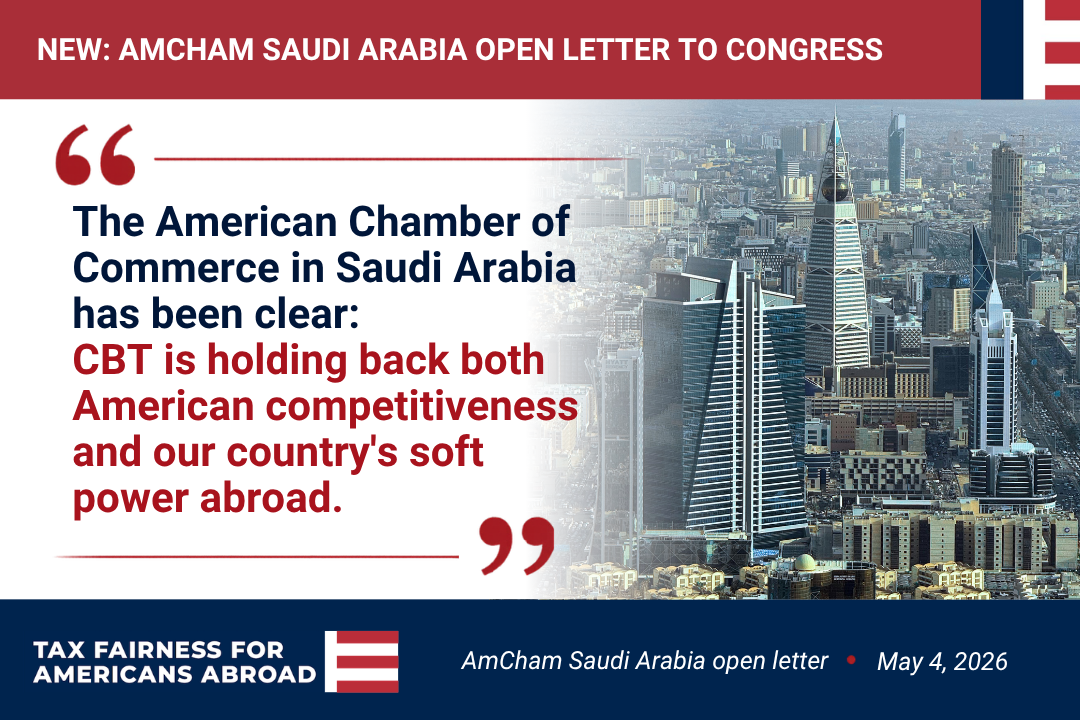
The American Chamber of Commerce in Saudi Arabia has been clear: CBT is holding back both American competitiveness and our country's soft power abroad. Nowhere is this more apparent than in Saudi Arabia, a key ally and economic partner. Vision 2030, the Kingdom's ambitious plan to diversify its economy, depends on global expertise. American companies want to help realize that vision, but the U.S. tax code makes it nearly impossible to recruit qualified American talent without requiring expensive “gross-up” compensation to offset IRS obligations.
Consider a realistic example: an American executive offered a leadership role in Riyadh with a good salary would lose any financial advantage after paying U.S. taxes (potentially tens of thousands of dollars), housing, relocation, and family costs. Many simply decline these roles. Others renounce their citizenship altogether to escape the complexity. One dual U.S.–Saudi citizen who recently faced a multimillion-dollar inheritance tax in Jeddah made that heartbreaking decision. The U.S. lost not just a taxpayer, but a capable professional and global advocate.
The double damage is clear. U.S. influence abroad erodes as Americans withdraw from international roles, leaving gaps filled by professionals from nations with fairer, residence-based tax systems. Meanwhile, host countries such as Saudi Arabia, actively seeking American expertise to advance joint initiatives, are forced to look elsewhere.
RBT offers a better way forward
The Residence-Based Taxation for Americans Abroad Act, originally introduced in the last Congress and now being revised with a view to reintroducing it soon, offers a way forward. This bipartisan approach would align U.S. tax policy with international norms by taxing citizens based on where they reside and benefit from public services, not simply where they were born. Such reform would eliminate double taxation, revitalize overseas mobility, and boost trust in America's leadership on global economic cooperation.
Moreover, residence-based taxation complements other U.S. initiatives, including the new $5 million Golden Visa program designed to attract foreign investors. Without embracing residence-based taxation, that program would be difficult to implement; no investor would pay millions to gain citizenship that unleashes lifetime global tax obligations.
American companies are deeply engaged across many sectors in Saudi Arabia, including defense and security, energy and petrochemicals, infrastructure and construction, healthcare, education, technology, and financial services. These industries rely on the ability to recruit and retain U.S. talent abroad; ending double taxation would make American firms far more competitive partners in delivering projects that advance both U.S. and Saudi priorities.
While Americans living abroad represent a small share of the overall U.S. electorate, their votes can be decisive in close elections, and they pay close attention to how members of Congress stand on issues that affect their livelihoods. Ending double taxation and removing the administrative burdens of CBT are issues that the roughly five million Americans overseas care deeply about; they will want to know which members support reform and which do not.
We recognize that Congress has a multitude of competing priorities. To push this essential reform to the top of the legislative stack, we urgently request that the House Ways and Means Committee and the Senate Finance Committee direct the Joint Committee on Taxation to prioritize analysis of residence-based taxation and finish the work already begun. Every year we wait, more Americans abroad are pushed away, more partnerships falter, and more opportunities to advance U.S. interests are lost.
Congress must act now so America’s citizens, wherever they live, can work, contribute, and thrive without penalty.
Sincerely,
Erich Phillips
Executive Director
AmCham Saudi Arabia
If you are an American living abroad and also suffer from double taxation, please help us in the fight for residence-based taxation! Share your own story on our Help us page and Donate using the button below! Our campaign is 100% financed by individual donations and every donation brings us one step closer to winning!