
How double taxation and FATCA hurt Americans abroad
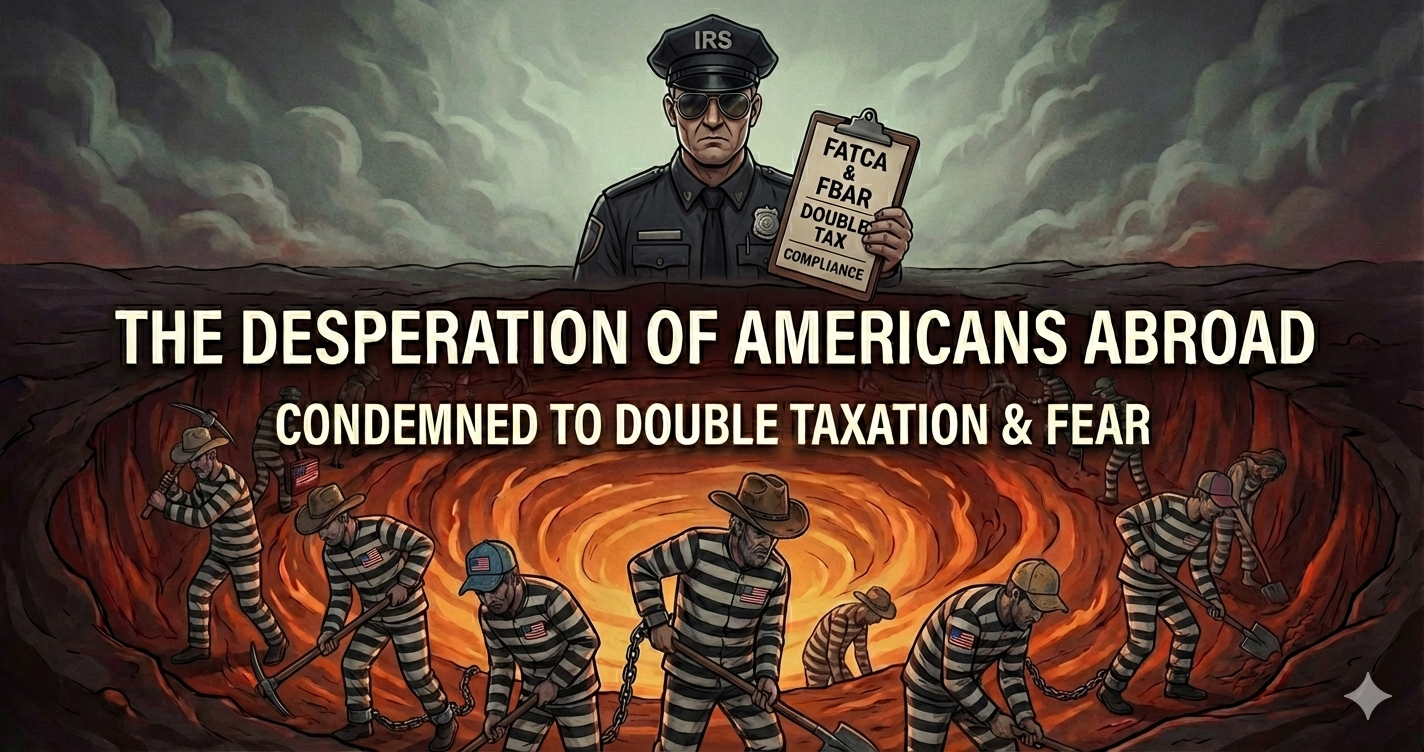
AI-generated image
Dear Congress,
Americans living abroad are increasingly vocal about how U.S. double taxation and FATCA rules are damaging their financial security, retirement planning, and basic access to banking. From blocked local investment accounts to complex PFIC reporting on foreign pensions, ordinary Americans abroad describe a system that treats them like tax residents of two countries at once.
In recent comments on our website’s donor wall, donors share firsthand how citizenship-based taxation, FATCA compliance costs, and fear of devastating penalties are pushing them toward drastic choices such as renouncing U.S. citizenship. Their stories reveal the high human cost of double taxation and FATCA for Americans trying to build normal lives outside the United States—and for the United States, which stands to lose citizens because of its failure to address the problem.
Double taxation and blocked retirement savings
Double taxation and the uniquely American punitive treatment of foreign retirement savings come up repeatedly as core grievances. Joseph, who obtained U.S. citizenship in his 50s after years of close ties with the country, explains that returning to Ireland exposed him to a “nightmare” he had not anticipated. He is particularly struck by how “locked away Irish company sponsored retirement funds” he had before becoming a U.S. citizen are now “pulled into the net of PFIC reporting.” His tax advisor is “strongly advising” him to renounce, and he is effectively giving the system until 2026—if the bill doesn’t pass, he feels he has “to give it up.”
Another donor, Anne, notes that she lives “in the country with the highest tax rate in the world” and “owe[s] nothing to the US, as [she has] never benefited from its services,” yet still faces U.S. filing obligations and the risk of double taxation. For her, “double taxation…is theft, no less,” and she adds that she “cannot open a savings account” abroad and cannot afford the cost of renouncing U.S. citizenship, which would be “much more than a month’s salary.”
Compliance burden, cost, and fear of renunciation
Many donors stress that the cost and complexity of compliance are unsustainable—even when their actual U.S. tax liability is small or zero. One anonymous donor from Canada explains: “I am fully compliant as a high-earning U.S. person living in Canada who actually pays a negligible amount of tax to the U.S. each year. The real problem for me is the expensive accounting required, the time needed to file IRS and FATCA forms, and the investment opportunities not available to me (e.g. mutual funds, TFSA and RESP accounts).” They conclude that “the only beneficiaries to citizenship-based taxation are the accountants, tax lawyers, and bureaucrats who implement it.”
A different anonymous donor states plainly: “The cost of compliance is unbearable – it is not fair, punitive and pushing Americans abroad away. It pains to read folks are considering renouncing citizenship.” Several comments reference renunciation directly. Joseph is considering it on professional advice if reform does not pass. Anne says she “cannot afford” to renounce even though she feels trapped.
Behind these decisions is a sense of desperation rather than opportunism. Thomas Nicolas urges: “Let’s end this unfair taxation for medium-income expats!” Nicholas writes that “putting an end to this injustice would be a dream come true for so many of us suffering the effects every day.”
Barriers to normal financial life abroad
Donors repeatedly describe being locked out of ordinary financial tools in their countries of residence simply because they are “U.S. persons.” Tony Salameh lists the inability to open brokerage accounts, invest in local mutual funds or ETFs, or contribute to IRAs, all because of U.S. tax and reporting rules. The anonymous donor in Canada cites being shut out of key Canadian vehicles like the TFSA and RESP that are entirely normal for their neighbors.
Christian provides a detailed account of how rules like PFIC and CFC obligations distort normal life: “Onerous tax obligations imposed by the IRS, such as citizenship-based taxation, PFIC, CFC, and other tax regulations, make it prohibitively difficult for a good-faith taxpayer to remain compliant with U.S. taxes while maintaining a life overseas.” He notes that as someone who has “worked and lived in Europe,” he has “been denied access to banking services, investment opportunities, accounts at financial institutions, employment, and entrepreneurial opportunities solely because of [his] ‘U.S. Person’ status.”
Another donor, Joshua, relates how the U.S. tax system doesn’t just affect him but also his local partner: “I’ve spent countless hours trying to figure out to stay in compliance. I’ve also created endless headache for my non-American national business partner as he’s now under the requirements of the American taxation system as well as his own.”
Feeling taxed like residents, without resident benefits
Several donors emphasize the disconnect between being taxed as if they lived in the U.S. and the reality of having lives fully based abroad. Tony Salameh captures this bluntly: “We are expected to follow the tax rules as if we were residents of the U.S.. However, we do not receive the same benefits as residents.” He explains that Americans abroad “cannot open brokerage accounts without a U.S. address,” “cannot make contributions to an IRA without a brokerage account,” and “cannot invest in mutual funds or ETFs in a foreign country without painful high tax and reporting ramifications.”
For many, the system feels less like citizenship and more like a shakedown. One anonymous donor states that they hope their “modest donation” will put an end to a “cauchemar” (nightmare) so that they can finally benefit from the advocacy work being done on their behalf. Another donor, Patricia Leroux, echoes this sentiment, asking, “Bientôt la fin de ce cauchemar ? Espérons, espérons !...” (“Soon the end of this nightmare? Let’s hope, let’s hope!”).
Emotional toll and desire for a normal future
Beyond numbers and forms, the emotional and psychological toll is evident. Matthew Coleman writes simply: “I just want to be able to live my life.” One anonymous donor says that a legislative “win would be life-changing for me and other U.S. citizens abroad who are just trying to plan for more financially secure futures!” Christine similarly shares that passage of residence-based taxation “would change my life and that of my dual-citizen adult children!”
Many donors express gratitude but also urgency. Mark Turner thanks TFFAA for its “tireless efforts to end the insanity of citizenship taxation.” Another anonymous donor thanks the organization for its work and stresses that the current regime is “pushing Americans abroad away.” Edward calls the cause “just” and commits to keep giving his “modest sum as long as you have the will to continue to fight this battle.”
Taken together, these voices—named and anonymous—paint a clear picture: Americans abroad are not asking for special treatment. They are asking to be treated like every other emigrant population in the world, free to build savings, businesses, and families where they live without being punished by a tax system still tethered to a country many of them rarely benefit from and increasingly cannot afford to remain citizens of.
Sincerely,
Tax Fairness for Americans Abroad
If you are an American living abroad and also suffer from double taxation, please help us in the fight for residence-based taxation! Share your own story on our Help us page and Donate using the button below! Our campaign is 100% financed by individual donations and every donation brings us one step closer to winning!