
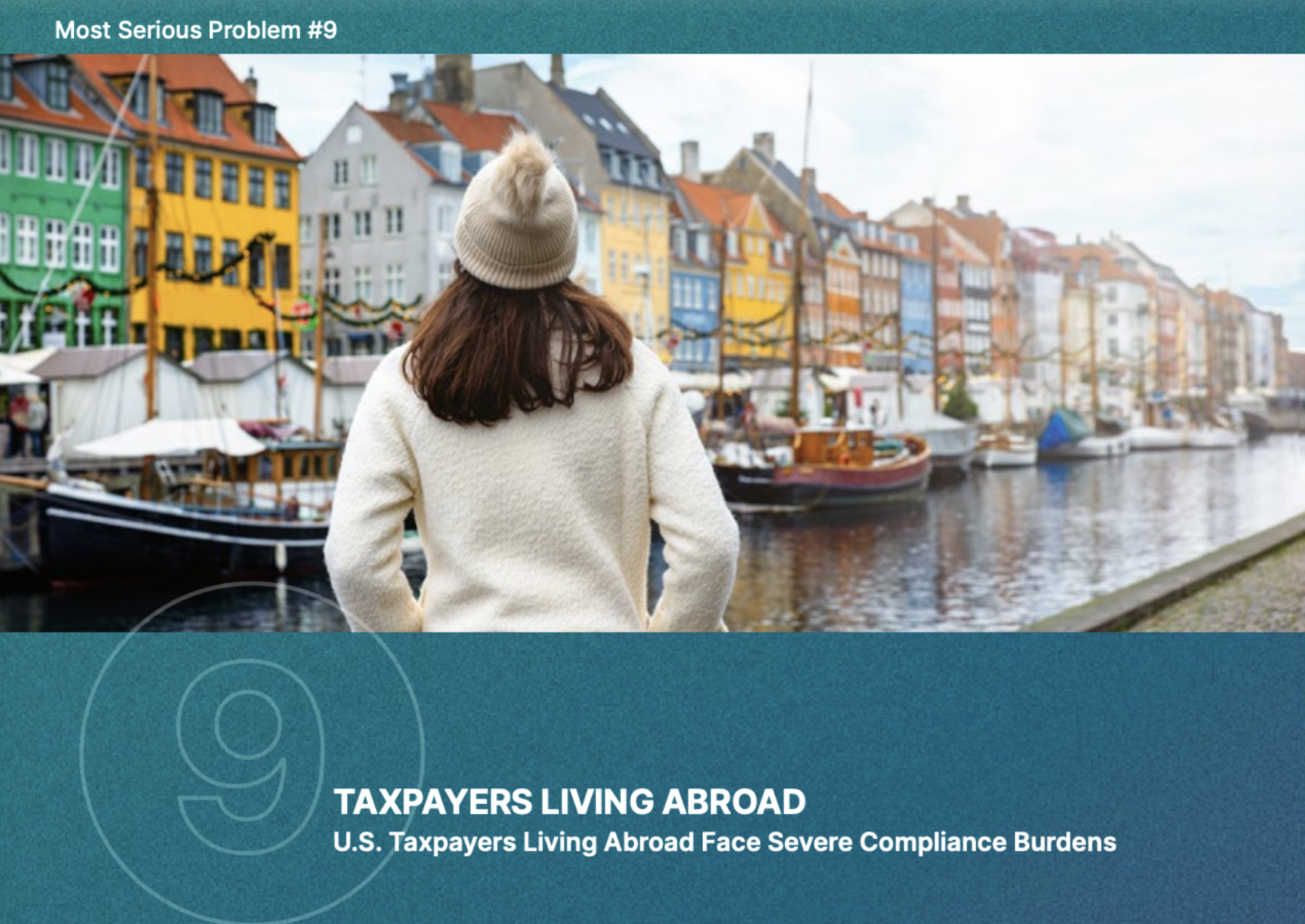
Chapter 9 of the US National Taxpayer Advocate’s report focuses on the double taxation woes of Americans abroad.
Today Erin Collins, the U.S. National Taxpayer Advocate, delivered her latest annual report—and called on Congress to grant Americans abroad a home-country exemption from FATCA filing obligations and eliminate duplication between the FATCA and FBAR forms.
While Ms. Collins’ report stopped short of calling for the repeal of the laws that inflict double taxation, high compliance costs and general misery on Americans abroad (which arguably goes beyond her mandate), her report to Congress laid out many good reasons that current law should be changed, backed up by numbers and examples.
“Excessive compliance burdens,” and the “lack of meaningful IRS support” together “infringe on their rights to be informed, to quality service, to pay no more than the correct amount of tax, and to a fair and just tax system,” the report says, referring to Americans abroad.
Kafkaesque reporting requirements
Tax Fairness for Americans Abroad welcomes the report’s detailed description of the myriad ways in which the current U.S system inflicts high costs and misery on Americans abroad as well as its recommendations for administrative relief. But Congress should not stop there, even if the NTA’s recommendations stop short of addressing all the Kafkaesque U.S. reporting requirements related to double taxation, including requiring Americans abroad to declare pension and retirement plans as Passive Foreign Investment Companies. The only comprehensive solution is Rep. Darin LaHood’s Residence-Based Taxation for Americans Abroad Act, which we hope to see reintroduced in both the House and Senate soon.
A former IRS Commissioner has also publicly endorsed a shift toward residence-based taxation for Americans abroad, underscoring that this is no longer a fringe position but a serious, mainstream policy proposal.
The National Taxpayer Advocate is an independent organization within the Internal Revenue Service (IRS) that acts as a sort of ombudsman for U.S. taxpayers. The NTA is appointed by the Secretary of the Treasury, reports directly to the IRS Commissioner, and is responsible for protecting taxpayer rights, helping taxpayers resolve problems with the IRS, and proposing systemic changes to tax administration.
FATCA and FBAR
While the NTA’s annual report has historically focused more on helping Americans comply with existing U.S. laws, this year’s report took particular issue with the unnecessary and ultimately counter-productive compliance burden of forcing Americans abroad to file both FATCA and FBAR declarations of foreign bank accounts.
The FATCA and FBAR reports request virtually the same information, and the U.S. government’s insistence that both individuals and non-U.S. financial institutions report on any accounts held by U.S. citizens has led many foreign financial institutions to simply refuse to serve Americans, or charge them extra because of the additional compliance burden for “banking while American.”
“These reporting regimes are complex, overlapping and punitive,” the NTA report says. “Taxpayers may face harsh penalties for failing to file or to timely file required forms even when no U.S. tax is owed.” As a result, the report goes on to say, “taxpayers living abroad face significant compliance challenges and potentially severe penalties that domestic taxpayers do not.”
The report calls on Congress to grant Americans abroad a “country-of-residence” exemption from the obligation to file FATCA forms on the basis that “accounts opened by U.S. citizens in a foreign country of bona fide residence generally have legitimate purposes and are not ‘offshore’ accounts used for tax avoidance.” Hear, hear!
Original sin
Rather than stopping there, however, the report also laid out the fundamental injustice that the U.S. insists on taxing its citizens on the basis of their citizenship rather than residence. Because of that situation, which some call the original sin, compliance for those abroad is “complex, confusing, and often expensive,” the report says.
In fiscal year 2023, according to the report, 81% of Americans filing income taxes from abroad earned less than $100,000, which is less than the $130,000 Foreign Earned Income Exclusion amount for that year. That means millions of Americans abroad have to go through the expense and hassle of hiring an expert tax preparer just to prove that they owe the IRS nothing. As TFFAA’s tax preparation calculator demonstrates, even Americans abroad who never owe U.S. taxes can end up paying small fortunes in accounting fees—money they should be putting to better use such as saving for retirement.
Given this, Tax Fairness for Americans Abroad continues to campaign for a permanent, comprehensive fix: giving Americans abroad the option of being taxed based on their residence and source of income—just like the citizens of every other democratic country on Earth.
To learn more about our campaign, to share your own experiences trying to comply with two different tax codes, or to volunteer or to donate to our campaign for change, please click the blue button below and visit the rest of this site. Our campaign is 100% donation-funded and volunteer-run and depends on the support of individual Americans abroad to succeed.