ABCK – AmCham Kuwait says citizenship-based taxation weakens U.S. competitiveness
Dear Members of Congress,
The American Business Council – American Chamber of Commerce Kuwait (ABCK–AmCham Kuwait) respectfully writes to urge Congress to adopt a residence-based taxation framework for non-resident U.S. citizens and to abolish the current citizenship-based taxation system. The United States stands as one of only two countries in the world that taxes its citizens on the basis of citizenship rather than residence. That system is inequitable, outdated, and must be reformed.
Kuwait is home to a significant American community, and for more than four decades, ABCK–AmCham Kuwait has served as a platform for American business engagement in the country. Since 1985, our organization has represented a diverse network of multinational corporations, small and medium-sized enterprises, entrepreneurs, executives, and business leaders committed to advancing U.S.–Kuwait trade, investment, and commercial cooperation.
Our mission is to support the growth of the bilateral economic relationship by building connections, facilitating constructive dialogue, and providing opportunities for advocacy, education, networking, and capacity building.
Our membership reflects the breadth of the U.S.–Kuwait commercial relationship, with companies and professionals active across major sectors of the economy, including energy, defense, aviation, finance, logistics, healthcare, education, technology, infrastructure, and professional services.
The success of these businesses depends on their ability to deploy qualified and experienced professionals internationally. Americans working abroad are indispensable to overseeing operations, sharing expertise, developing partnerships, and representing American business standards globally. The current tax system actively undermines this capacity.
In Kuwait, American professionals are essential to both the commercial relationship and the broader partnership between the United States and Kuwait. Their presence drives business development, knowledge transfer, long-term institutional relationships, and the effective delivery of projects involving American companies and expertise.
At the same time, Americans living abroad must navigate a tax and financial-reporting system that can be complex, particularly when U.S. requirements interact with the laws, banking systems, and employment structures of the countries in which they reside. No other developed nation imposes this burden on its citizens. The citizenship-based taxation system is an anomaly that must be replaced.
While existing provisions, including the foreign earned income exclusion, foreign housing provisions, and foreign tax credits, provide partial relief, they do not remedy the fundamental inequity of the citizenship-based system. Compliance still demands significant time, expense, and professional support that no other country requires of its non-resident citizens.
This imposes a direct competitive disadvantage on American workers and businesses.
Companies assigning American personnel overseas are forced to provide tax advisory support, tax-equalization arrangements, and additional compensation simply to offset the unique burden that U.S. citizenship-based taxation imposes. No comparable obligation falls on employers of non-U.S. nationals in the same roles. This structural disadvantage discourages international assignments and weakens the competitive position of American companies globally.
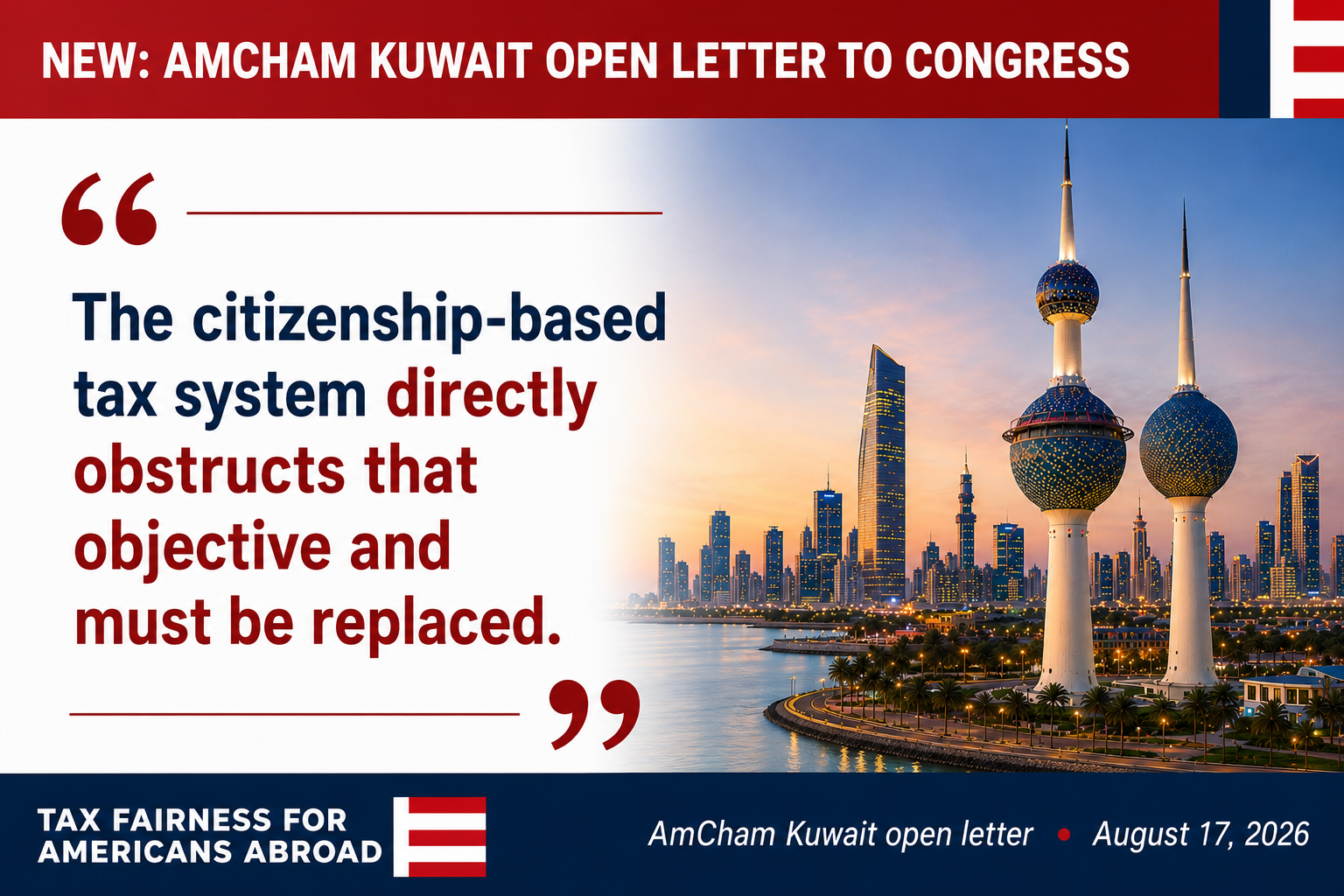
It is a clear economic and strategic imperative that Americans be well positioned to accept international roles and contribute to the success of U.S. companies overseas. The citizenship-based tax system directly obstructs that objective and must be replaced.
Kuwait is an important market for American business and expertise. The U.S.–Kuwait relationship is longstanding and spans defense, trade and investment, cybersecurity, healthcare, education, technology, and other areas of mutual interest.
Kuwait’s national development priorities also create meaningful opportunities for U.S. companies, particularly as the country seeks to diversify its economy, increase private-sector participation, attract investment, and improve the business environment.
American companies and professionals are well placed to contribute to these objectives but the citizenship-based tax system places them at a structural disadvantage relative to competitors from every other major economy. Adopting a residence-based taxation framework is essential to enabling greater American participation in these and other international opportunities.
The Residence-Based Taxation for Americans Abroad Act, introduced during the 118th Congress as H.R. 10468, provided a constructive framework for an elective residence-based income-tax regime for qualifying nonresident U.S. citizens. Congress must reintroduce and pass this legislation without further delay.
The failure to enact this legislation during the 118th Congress must not be repeated. The underlying principles are sound, the case is compelling, and the time for action is now.
ABCK–AmCham Kuwait calls on Congress to abolish citizenship-based taxation and replace it with a residence-based taxation system that recognizes the circumstances of Americans who genuinely reside and work outside the United States while maintaining appropriate safeguards, eligibility requirements, and protections against abuse.
A well-designed residence-based taxation system will simplify compliance, provide certainty for individuals and employers, support international mobility, and enable American companies to compete on equal footing in global markets.
This issue is not about avoiding legitimate tax obligations. Rather, it is about considering whether the current framework can be modernized to better reflect the realities of a global economy in which Americans live, work, invest, raise families, and represent U.S. commercial interests around the world.
We recognize that any reform in this area requires careful consideration of revenue implications, administrative feasibility, anti-avoidance safeguards, and the interaction between taxation and international financial-reporting requirements.
We therefore call on Congress, including the House Committee on Ways and Means and the Senate Committee on Finance, to act decisively to enact residence-based taxation for Americans abroad, and to direct the Joint Committee on Taxation and other relevant bodies to provide the technical support necessary to do so.
The case for reform commands bipartisan support across party lines, among tax experts, government agencies, American businesses operating internationally, and the millions of U.S. citizens residing abroad who are directly harmed by the current system. Congress should move forward with urgency.
Abolishing citizenship-based taxation and adopting a residence-based framework will strengthen American competitiveness, facilitate the deployment of U.S. talent overseas, and affirm Congress's commitment to the Americans abroad who work every day to advance U.S. commercial and strategic interests.
ABCK–AmCham Kuwait urges Congress to act now to end citizenship-based taxation and adopt a fair, practical, and durable residence-based taxation system for Americans living and working abroad. The time for study has passed and the time for action is now.
Sincerely,
Dr. Arezou Harraf
Chair of the Board of Directors
American Business Council – American Chamber of Commerce Kuwait
If you are an American living abroad and also suffer from double taxation, please help us in the fight for residence-based taxation! Share your own story on our Help us page and Donate using the button below! Our campaign is 100% financed by individual donations and every donation brings us one step closer to winning!